Monday November 9th 2026
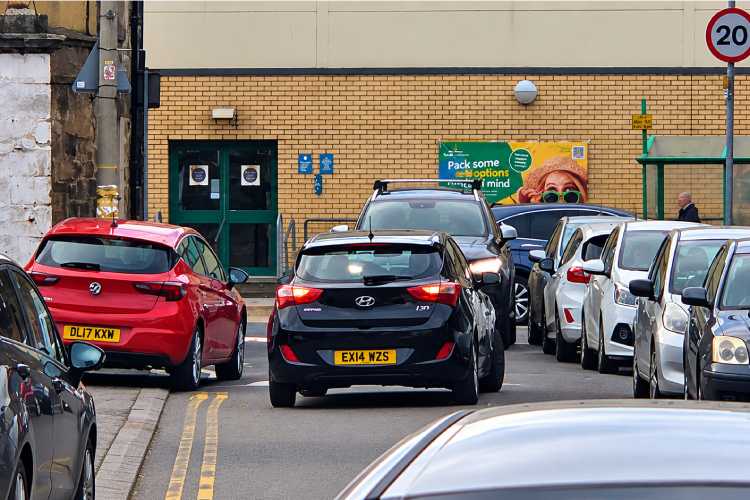
Pavement parking in Dalkeith
Written by Philip Reilly, Croft Street resident, Dalkeith
The recent news that Midlothian Council is considering parking charges, residents’ permits and controlled parking zones raises important questions about how parking decisions are made, how residents are consulted and whether longstanding concerns are genuinely being addressed.
As a resident of Croft Street in Dalkeith, I have spent several years raising concerns about parking enforcement, road safety, commuter parking and the effectiveness of restrictions surrounding King’s Park Primary School.
My experience suggests that residents across Midlothian should be asking more questions about the Council’s proposed approach before future parking decisions are made.
Residents’ parking: a change in direction?
In previous correspondence, Midlothian Council informed me that it had no policy or plans for residents’ parking schemes, describing such arrangements as normally associated with city authorities.
The Council also relied on a residents’ parking consultation carried out in 2019, stating that the majority of feedback did not support progressing a scheme.
However, when I previously queried that consultation, my recollection is that the explanation focused on insufficient responses and financial considerations.
These explanations may be reconcilable, but residents deserve access to the actual consultation results, including how many households were contacted, how many responded and what proportion supported or opposed the proposals.
Now, seven years later, the Council’s draft parking strategy is considering residents’ permit zones and other localised controls where residential parking demand is particularly high.
This raises an obvious question: if these measures are now considered legitimate options, why have residents previously been given such categorical explanations for why they were not being pursued?
What does meaningful consultation actually look like?
In my experience, the difficulty is not simply that the Council reaches decisions residents disagree with. It is that residents can struggle to understand what evidence informed those decisions and whether their concerns have genuinely influenced the outcome.
Earlier this year, the Council informed Kirsty McNeill MP’s office that Road Services was working closely with Croft Street residents and that residents had already been advised of a parking strategy review.
Despite years of correspondence with Road Services, I had received no such notification.
When clarification was requested, the Council explained that it was developing a Midlothian-wide parking strategy. It did not identify which Croft Street residents it had been working closely with.
This distinction matters.
There is a considerable difference between informing residents that a county-wide strategy is being developed and actively engaging with them about the specific problems affecting their streets.
Consultation should provide residents with a genuine opportunity to influence proposals before decisions are reached.
Parking enforcement: activity is not the same as effectiveness
The Council has previously referred to the number of Penalty Charge Notices issued in Croft Street as evidence that enforcement is taking place.
However, the number of tickets issued does not necessarily establish whether enforcement is sufficient to address the scale of the problem.
Over more than two years, I have compiled hundreds of dated photographs documenting recurring parking conditions, repeat vehicles and apparent breaches of restrictions.
The Council has pointed out that individual photographs do not necessarily establish that a contravention has occurred because the surrounding circumstances must be considered.
That is a reasonable principle. However, residents’ evidence should be assessed in context, just as Parking Attendants consider restrictions and circumstances before deciding whether to issue a ticket.
A substantial record showing repeated patterns should not be dismissed simply because an individual photograph may not tell the whole story.
School Streets and road safety
Parking is also a matter of public safety.
Croft Street forms part of the area surrounding King’s Park Primary School, where School Street restrictions are intended to reduce vehicle movements at particularly busy times.
I have repeatedly raised concerns about vehicles entering during restricted periods, parking around junctions and obstructing safe turning movements.
The Council has explained that enforcement of School Street access restrictions is a matter for Police Scotland.
However, identifying the responsible enforcement authority does not answer whether the scheme itself is working effectively or whether its design and exemptions require reassessment.
Residents should be able to expect an evidence-based review of road safety, not simply a referral between departments.
Questions every Midlothian resident should be asking
The Council’s new strategy provides an opportunity to improve parking management. But residents should be seeking clear answers:
1. Will residents be consulted before specific parking changes are recommended or approved?
2. What evidence will determine whether a street qualifies for residents’ permits or additional controls?
3. Will the Council publish the results of previous consultations and explain how those results influenced decisions?
4. How will existing parking complaints, photographic evidence and residents’ observations be considered?
5. Will any new parking charges be assessed for their potential to displace commuter parking into neighbouring residential streets?
6. How will the Council measure whether enforcement and School Street arrangements are actually effective?
These questions matter whether residents support parking charges, oppose them or simply want a fairer system.
An opportunity to rebuild confidence
I recognise that parking management is complicated. Residents, businesses, schools, commuters and visitors all have legitimate needs, and the Council must balance competing interests.
However, that balancing exercise should be transparent.
Residents should not have to spend years corresponding with different departments simply to establish what policies apply, how decisions were reached or whether their evidence has been considered.
Nor should longstanding decisions be treated as beyond reconsideration simply because they were made under previous circumstances.
The Council’s new parking strategy is an opportunity to demonstrate that public concerns are being listened to and that future decisions will be based on current evidence.
My message to fellow Midlothian residents is simple: take an interest in these proposals, ask how your street may be affected, request access to the supporting evidence and make sure your views are heard before decisions are finalised.
The aim should not simply be to introduce more restrictions or generate parking revenue. It should be to create a parking system that is fair, transparent, effective and responsive to the communities it serves.
Philip Reilly is a resident of Croft Street, Dalkeith, and has been corresponding with Midlothian Council regarding parking and road-safety concerns for several years, with no results.
Tweet Share on Facebook