Wednesday November 18th 2026
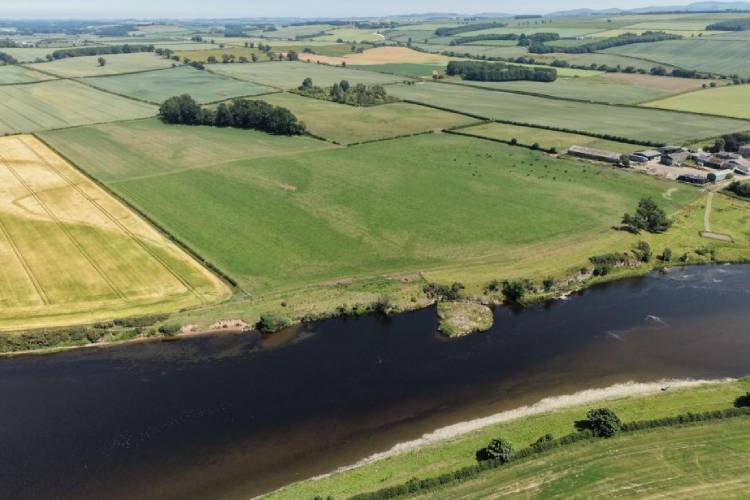
Site on far side of River Tweed at Whitmuirhaugh, Sprouston near Kelso (Image: AOC Archaeology/Destination Tweed)
Written by Local Democracy Reporter, Paul Kelly
Scottish Borders Council will require a farmer to carry out an archaeological ‘watching brief’ if approval is granted for a new straw shed on his land.
Jonny McCririck has submitted an application to SBC for an agricultural building at Whitmuirhaugh Farm in Sprouston.
The presence of an archaeological site located north of the modern village of Sprouston was first identified through aerial survey undertaken from 1970 which demonstrated extensive cropmarks representing a site with multiple phases and likely considerable chronological depth.
Recent survey and excavation work by AOC Archaeology, as part of the Uncovering the Tweed project, targeted several of the cropmark features, confirming good survival of features dating to the prehistoric, Anglian and medieval periods on the low gravel ridges north of the farmyard.
To safeguard the archaeological resource that the proposed development may disturb, an experienced field archaeologist must undertake a watching brief on the excavation of 16 postholes and any groundworks below 300mm associated with the development.
A report from AOC states: “All excavation must be undertaken with a view to avoiding damage to any archaeological features or deposits which appear to be worthy of preservation in situ.
“No archaeological deposits should be entirely removed unless this is unavoidable and agreed upon with the Scottish Borders Council archaeologist.
“The objective of the archaeological works is to determine the existence of any buried archaeological remains within the 16 postholes and minor groundworks by means of a programme of archaeological monitoring.
“The site of construction itself is not designated but it sits directly to the south of a multi-period site identified on aerial photos and a designated Scheduled Monument so there is potential to encounter previously unknown buried archaeological features if the development extends below the old ground surface.”
Tweet Share on Facebook