Tuesday November 24th 2026
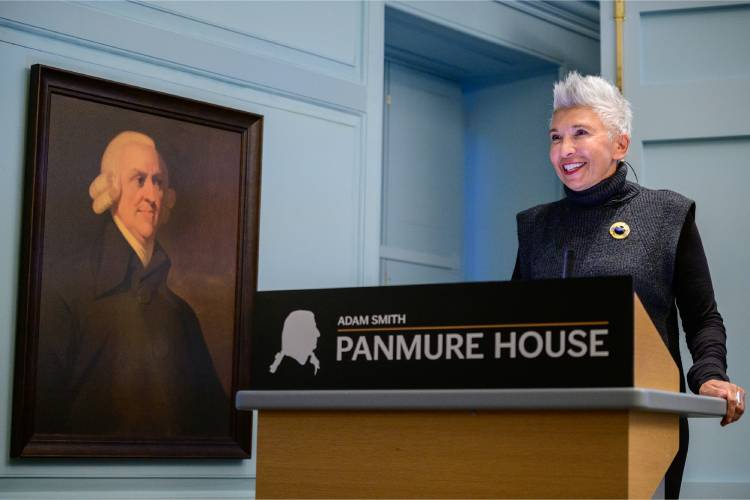
Professor Tima Bansal, Professor of Sustainability and Strategy at Ivey Business School in Canada, won the 2025 Panmure House Prize. It is awarded each year from Adam Smith's former Edinburgh home for research that champions long-term thinking.
Written by Midlothian View Reporter, Liam Eunson
A Canadian academic has returned to Edinburgh a year after winning a £56,000 prize to showcase a new tool designed to help businesses make more sustainable, long-term decisions.
Professor Tima Bansal, Professor of Sustainability and Strategy at Western University’s Ivey Business School, was awarded the 2025 Panmure House Prize for her research into why companies often feel forced to choose between short-term survival and long-term prosperity.
She returned to Adam Smith’s former home in Edinburgh to explain how the prize money has helped her team develop the Compass – a web-based tool designed to help business leaders understand the wider consequences of their decisions.
The Compass combines systems thinking with design thinking, allowing executives to consider how decisions could affect everything from supply chains and local communities to the climate.
With support from the prize, Professor Bansal and her team at Innovation North have developed the tool into a web application. It is currently being tested at universities in Canada, the United States, Iceland and Switzerland.
Speaking at a public lecture at Panmure House, Professor Bansal said the funding had allowed her team to turn the Compass into something that business leaders and students could use in practice.
She added: “Coming back to Panmure House, where Adam Smith thought so deeply about how complex societies work, feels very fitting. I’m grateful to the team here and to Heriot-Watt for backing long-term thinking at a time when it has never been more needed.”
The Compass guides users through four stages – frame, sense, imagine and act – helping them build a picture of the wider systems affected by a business decision without becoming overwhelmed by complexity.
Professor Bansal said traditional approaches often either simplify problems too much or attempt to map every detail, making it difficult for executives to identify practical solutions.
She said: “Executives are trained to make decisions in complex environments in one of two ways: reduce the complexity or seek to map it in full.
“The first produces answers that are clean, clear, and confident, but often wrong. The second produces maps that are difficult to act on. So, we need to show an alternative approach to decision making under complexity.”
The approach has already been put into practice. Working with CSA Group, Canada’s national standards organisation, Professor Bansal’s team mapped a route towards a circular built environment. The work led to the creation of the Circular Construction Hub, which is now running five pilot projects.
Professor Adam Dixon, Adam Smith Chair of Adam Smith’s Panmure House, said the research offered businesses a practical way to respond to increasingly complex challenges.
He said: “Too many businesses still run quarter to quarter, using decision-making tools that oversimplify complexity and inadvertently create harm at scale. Thinking long term counters this tendency and helps companies stay resilient and keep innovating.
“That is exactly what the Panmure House Prize exists to champion.”
The prize is awarded annually by Adam Smith’s Panmure House, part of Heriot-Watt University’s Edinburgh Business School, to recognise research promoting long-term thinking and innovation.
Professor Bansal’s research has included a 2017 study with Caroline Flammer which found that firms adopting long-term incentive plans increased in value and invested more in innovation.
She is ranked among the world’s top two per cent of scientists by Stanford University and Elsevier, and is a Fellow of the Royal Society of Canada.
Tweet Share on FacebookNews