Tuesday September 8th 2026
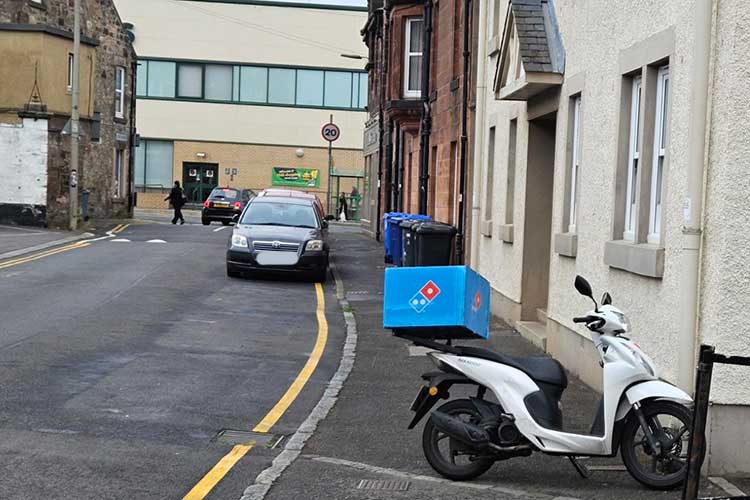
Parking on Croft Street, Dalkeith
This View has been written by Midlothian View reader, Philip Reilly
Residents and businesses across Midlothian may be interested to learn that Midlothian Council is currently developing a new Midlothian-wide parking strategy, with the present intention of taking a report before Council in November.
I discovered this not through a public consultation or widely advertised invitation for residents to contribute, but through correspondence concerning the longstanding parking and road-safety problems I have been raising on Croft Street in Dalkeith.
In a response provided through the office of Midlothian MP, the Council confirmed:
“The Council are currently in the process of developing a new Midlothian wide parking strategy.”
It went on to state that the work will consider the Council’s “wider approach to parking management” and that “the current plan is to have this report presented to November Council.”
That sounds potentially significant.
Parking pressures affect communities throughout Midlothian. Residents compete for spaces near their homes. Businesses depend upon accessible short-term parking and turnover of spaces. Commuters add pressure in certain areas. Schools create concentrated traffic at particular times. Parking restrictions require effective enforcement, while new developments can create additional demand.
A Midlothian-wide strategy therefore has the potential to influence all of us.
So where is the public conversation?
What exactly is being considered?
There are some basic questions that deserve answers before November.
What is within the scope of the new strategy?
What evidence is being used?
Will residents be consulted?
Will local businesses be consulted?
Will communities experiencing persistent parking pressures be specifically invited to submit evidence?
Will residents’ parking schemes be considered?
Will enforcement levels and resources be examined?
Will School Streets and the division of enforcement responsibilities between Midlothian Council and Police Scotland form part of the review?
And, crucially, will the public have an opportunity to influence the strategy before recommendations are presented to councillors?
These are not questions being asked simply because of one street in Dalkeith.
They matter because this is described by the Council itself as a Midlothian-wide parking strategy.
Croft Street provides one example of why public evidence matters
My own involvement arises from longstanding concerns regarding Croft Street in Dalkeith.
Over an extended period I have documented recurring parking problems, including apparent contraventions of restrictions, pavement parking, parking around junctions and situations which can restrict visibility for pedestrians and other road users.
There are also continuing questions surrounding the operation and enforcement of the School Street associated with King’s Park Primary School.
The Council has now confirmed that the information and correspondence I have provided regarding Croft Street will be passed to the colleagues developing the new strategy for consideration.
That is welcome.
But Croft Street cannot be the only community in Midlothian with evidence worth hearing.
Residents in Bonnyrigg, Penicuik, Loanhead, Gorebridge, Newtongrange and elsewhere will have their own experiences of parking pressures. Businesses will have another perspective. Parents and schools another. Disabled motorists and pedestrians another.
A genuinely strategic approach should seek those experiences rather than wait for people to discover that a strategy exists.
An opportunity to reconsider what previously wasn’t possible
The Council’s response concerning Croft Street contains another interesting point.
It states that Midlothian does not currently have plans or a policy for a residents’ parking scheme, describing such schemes as normally associated with city authorities.
But if Midlothian is now creating a new parking strategy, surely this is exactly the opportunity to consider whether policies previously unavailable should form part of the Council’s future approach.
That does not mean residents’ parking permits are necessarily the answer.
They may be appropriate in some locations and completely inappropriate in others.
The point is that a new strategy should begin by examining the problems and available solutions, rather than excluding potential solutions simply because they are not part of the existing policy framework.
Otherwise, what is the purpose of developing a new strategy?
Enforcement needs to be part of the discussion
There is also a difference between the number of enforcement visits taking place and whether enforcement is actually changing behaviour.
This distinction matters.
The objective should not simply be to maximise the number of Penalty Charge Notices issued. Effective enforcement should create sufficient deterrence that motorists comply with restrictions in the first place.
If the same behaviours continue repeatedly despite regular enforcement visits, that deserves examination.
Likewise, where particular restrictions cannot currently be enforced by Council Parking Attendants because responsibility sits elsewhere, a strategic review should ask whether the existing arrangement remains the most effective one.
A parking strategy should not simply catalogue the powers the Council currently possesses.
It should identify the problems Midlothian is likely to face over the coming years and determine what powers, policies and resources will be needed to address them.
November isn’t far away
There is still time for meaningful public involvement.
If consultation is already taking place, the Council should make clear where residents can find it and how they can participate.
If consultation is planned, residents should be told when it will begin.
And if the November report is only an initial stage before a more substantial public consultation, explaining that now would provide welcome clarity.
This should not become an argument between the Council and individual residents.
It is an opportunity.
Midlothian is growing. Traffic patterns are changing. Town centres face competing pressures from residents, businesses, commuters, schools, visitors and new development.
Creating a new parking strategy is therefore potentially a very positive step.
But a strategy designed for the whole of Midlothian should surely be informed by the people who park, live, walk, cycle, trade and travel within Midlothian every day.
The Council has confirmed that a new strategy is being developed.
Now residents deserve to know what is being proposed and how they can help shape it before November.
Tweet Share on Facebook