Friday September 25th 2026
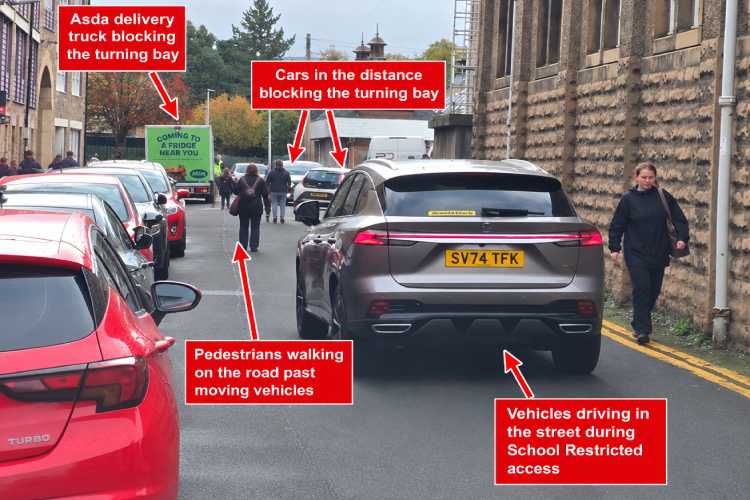
Example this week of safety issues near the school on Croft Street, Dalkeith
This article has been written by Midlothian View reader, Philip Reilly
After years of complaints, enforcement, correspondence and a School Streets scheme on Croft Street, perhaps it is time to stop measuring activity and start measuring results.
I first began raising parking and road-safety concerns affecting Croft Street in Dalkeith in approximately 2017.
It is now 2026.
During those nine years there have been countless emails, complaints, photographs, Freedom of Information requests and discussions with Midlothian Council about parking enforcement, King’s Park Primary School and the School Streets restriction.
I have been told what Parking Attendants can enforce, what Police Scotland must enforce, where pedestrians are encouraged to walk and which Council process deals with which issue.
But after nine years, I believe residents are entitled to ask a much simpler question:
What has actually improved?
Has parking compliance improved?
Have problems around the Croft Street/Eskbank Road junction reduced?
Has the School Streets restriction reduced vehicle movements to a safe and effective level?
Has pedestrian safety improved?
And has the Council actually measured any of this?
If it has, residents should be shown the evidence.
21 apparent unauthorised entries in one day
One day this week, I observed the School Streets restriction during both operating periods.
I recorded 21 vehicle entries which appeared not to fall within the permitted categories — 12 in the morning and nine in the afternoon.
Croft Street is a dead end, meaning those entries potentially created 42 vehicle movements as vehicles entered and subsequently left.
That morning, the situation produced a rather extraordinary consequence for me personally.
At around 8:55am I was ready to leave home in my own vehicle. As a resident, I was permitted to do so.
Instead, I sat in my parking space for approximately nine to ten minutes.
There were already so many pedestrians and vehicle movements that I did not consider adding another vehicle sensible.
Nobody physically prevented me from leaving. But in practical terms, I felt effectively trapped in my own street because remaining stationary seemed the safer option.
Surely that deserves investigation in a street where the restriction specifically exists to reduce traffic and improve road safety.
Who enforces it isn’t the only question
The Council has repeatedly explained that enforcement of the School Streets vehicle restriction rests with Police Scotland.
I understand that.
But identifying the enforcement authority does not answer whether the Council’s own road-safety intervention is working.
Midlothian Council says School Streets are intended to increase road safety, reduce traffic and congestion, reduce inconsiderate parking and dangerous manoeuvres, and encourage active travel.
These are outcomes which can be measured.
So has Croft Street been measured against them?
How many vehicles are entering during restricted periods?
Is that number rising or falling?
What are the pedestrian movements?
How frequently are morning and afternoon conditions actually observed?
Has the scheme become safer and more effective over time?
Those questions matter more than another explanation of departmental responsibilities.
Residents’ evidence deserves proper consideration
I also accept that an individual photograph does not necessarily prove that a parking contravention has occurred. The circumstances of each case have to be considered.
But Parking Attendants do not issue tickets simply because they have taken a photograph either. They assess the restriction and circumstances first, with photographs forming part of the evidential record.
Residents’ evidence should be considered just as sensibly.
I am not relying upon isolated photographs.
I have compiled a substantial contemporaneous record over more than two years showing repeated parking behaviour, recurring locations, repeat vehicles and apparent breaches of restrictions.
The significance is the pattern.
“Working closely with residents”
There is also one statement which deserves clarification.
In correspondence with the office of Midlothian MP Kirsty McNeill, the Council has described its ongoing interaction concerning these issues in terms of working or corresponding closely with residents.
As a resident who has corresponded extensively with the Council, I would welcome clarification of what meaningful resident engagement has actually taken place.
Who has been engaged?
Have meetings or joint site visits taken place?
What problems have residents and officers identified together?
What potential solutions have been discussed?
And what has changed as a result?
If meaningful engagement is taking place, I would genuinely welcome being part of it.
Activity is not the same as improvement
This is ultimately much bigger than one street, one resident or one Council officer.
Parking Attendants can patrol.
Police Scotland can occasionally enforce.
Consultations can take place.
Emails can be answered.
Complaints can be closed.
Those are activities. They are not outcomes.
After approximately nine years, the measure of success should surely be whether conditions have actually improved.
This is particularly timely because Midlothian Council is supposedly now developing a new Midlothian-wide parking strategy, with a report currently planned to go before Council in November.
That provides an opportunity not simply to explain the existing system again, but to ask whether it is delivering what Midlothian needs.
So our expectations of Midlothian Council is straightforward:
Show us what has improved.
If the evidence demonstrates that the current approach is working, publish it in detail.
If that evidence does not exist, then perhaps after nine years it is time to start measuring the outcomes and, where necessary, change the approach.
The question is no longer simply how the system works.
The question is whether it works.
Tweet Share on Facebook