Wednesday October 7th 2026
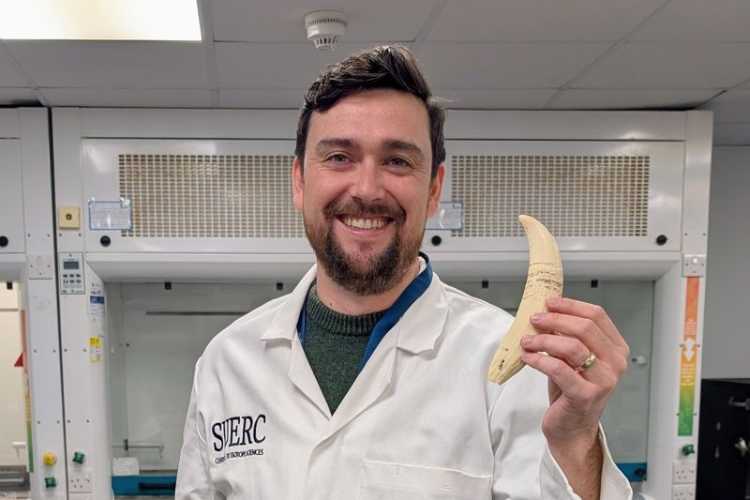
Dr Kieran Tierney holds a whale tooth at SUERC
Written by Midlothian View Reporter, Liam Eunson
New analysis of traces of radioactive fallout from nuclear weapons testing trapped in the teeth of stranded whales has helped scientists reconstruct their life stories.
A team of researchers from Scottish universities and museums used sophisticated radiocarbon dating techniques on samples of whale teeth to create a kind of dental time machine.
Each growth layer in a whale’s tooth is thought to form annually, like the rings of a tree. The researchers tested that assumption for the first time in sperm whales and killer whales by using bomb radiocarbon.
These harmless trace radiocarbon signals, together with stable isotopes, provided clues about where the whales called home, what they ate, and how long they lived.
Conclusions drawn from those clues have enabled the researchers to roll back the years to uncover details about the whales’ lives.
Their findings, published as a paper in the journal Frontiers in Marine Science, are based on the analysis of teeth collected from two sperm whales and three killer whales who died on Scottish shores in decades past.
The outcomes of the study could help broaden scientists’ understanding of the life cycles of the two whale species, with one killer whale studied being among the oldest known males of his type ever documented.
The paper also provides new insight into how whales’ teeth develop as they age. Their analysis represents some of the first direct evidence that tooth growth layers are created annually during early to mid-life, and suggests that they become less reliable as an age marker as the marine mammals enter their senior years.
The teeth analysed included samples from two high-profile Scottish whale strandings. Sperm whale Moby, whose skull is today on display in the National Museum of Scotland, became stranded on mudflats along the Firth of Forth in 1997. Lulu, a member of the West Coast Community pod of killer whales, washed ashore on Tiree in 2016 with signs of entanglement.
The research was led by scientists at SUERC: Centre for the Isotope Sciences in partnership with researchers from the Universities of Glasgow, Edinburgh and St Andrews and National Museums Scotland.
For the paper’s lead author Dr Kieran Tierney, of SUERC: Centre for the Isotope Sciences, the research has a personal resonance. He said: “My parents took me to see Moby when he arrived in the Firth of Forth in 1997, when I was six years old. A few days later, we saw pictures of him dead on the shore, and I had so many questions: How could this huge, amazing animal die so suddenly? Where had he come from? What sort of life had he had?
“Those questions have always stayed with me, and they have been a fundamental part of what has driven my career at the overlap of marine science and isotope research. To be able to hold one of Moby’s teeth 30 years later and do work which helps us understand a bit of the life he had is something I’m really proud of.”
The team used SUERC’s accelerator mass spectrometer to analyse the relative abundance of radiocarbon found in each layer of the whales’ teeth. Large amounts of radiocarbon were released when atmospheric nuclear weapons testing began in the mid 20th century, and the fallout from those tests entered ecosystems both on land and in the sea.
The decay of radiocarbon is the basis of conventional radiocarbon dating. In this study the team took advantage of the distinctive rise and decline in radiocarbon caused by nuclear weapons testing and its subsequent cessation. Comparing this signal with the radiocarbon preserved in the tooth layers allowed them to determine whether layers formed before, during or after weapons testing and estimate when different parts of the tooth were created.
The team also examined stable isotopes of carbon and nitrogen in the tooth samples, tracers that can reveal changes in the animals’ diets and provide clues about where the animals were feeding throughout their lives.
Their analysis revealed a wealth of new data about the lives of the whales. Their testing showed that Moby was at least 43 years old when he died in 1997, since the innermost layers of his teeth were formed before fallout from nuclear weapons testing affected the marine environment. The other sperm whale whose teeth they analysed, meanwhile, was younger than Moby when he was stranded on an Orkney beach in 1994. In both sets of their teeth, the formation of their tooth layers corresponded closely to the carbon-14 record, suggesting strongly that their teeth were renewed annually.
Both sperm whales showed rising nitrogen isotope values in their teeth as they aged. That finding is consistent with previous research showing that male sperm whales are born in warmer subtropical waters before moving to cooler, higher-latitude waters as they mature. As they grow, reaching 40 feet or more, they target larger prey in deeper waters.
Analysis of the three killer whales’ teeth revealed some unexpected results. While the teeth of one male, stranded in Shetland in 1995 and likely younger than Moby when he died, showed an annual layer pattern, a second male stranded on South Uist in 2015 produced a much more surprising result.
Counting the layers in the tooth suggested he would be around 50 placing his birth in the early 1960s. But the radiocarbon record placed his birth as pre-weapons-testing radiocarbon levels. The team deduced that the layers became increasingly compressed, and no longer presented a clear record of his age. The radiocarbon evidence suggests he was around 65 or perhaps even older, which would make him one of the oldest male killer whales on record.
The tooth taken from Lulu, who died in 2016, showed no clear sign of the nuclear-weapons testing signal. Instead, her tooth carried a different radioactive fingerprint, the distinctive ‘Sellafield signal’ produced by radiocarbon discharges into the Irish Sea from the Sellafield nuclear reprocessing facility and carried to the west of Scotland.
The strength of the signal, which the researchers say is one of the first demonstrations that radiocarbon released from a civil nuclear facility can be recorded in whale teeth, suggested Lulu largely foraged off the west coast throughout her life. Her tooth carries this distinguishing marker for the West Coast Community of killer whales – a marker which the old male found on South Uist lacked, suggesting he was not part of the group.
Analysis of the stable isotopes showed the three killer whales had different feeding habits. Lulu had the highest nitrogen isotope values, pointing to her role as an apex predator in Scottish waters with a diet likely containing a higher proportion of marine mammals. The Uist male’s values were slightly lower, and the Shetland male’s lower again suggesting larger contributions of fish in their diets. The West Coast Community is thought to eat marine mammals as at least part of its diet. While the data cannot show exactly what each whale ate, they do show clear differences in the prey they relied on.
Dr Tierney added: “The effectiveness of conserving and managing marine mammal populations depends on how well we understand their life histories, and ecology.
“This study looked at five whales, so its scope is limited, but it provides new information which we think may be useful to help conservation efforts in the years to come. It could help improve how we interpret age and life-history records in these animals.
“We’ve provided new evidence to show that tooth growth layers are deposited annually but this is perhaps only reliable up to a certain point in their lives. We have identified a particularly old male killer whales who was likely significantly older than the growth layers suggest.
“By combining radiocarbon with stable isotope analysis we can get a much richer picture of how these animals lived. We hope that this study adds a useful piece to our ever-growing understanding of the life-histories of these two whale species.”
The teeth used in the study were provided from the collection of the Scottish Marine Animal Stranding Scheme (SMASS), which were archived by SMASS and National Museums Scotland after post-mortem examination.
The team’s paper, titled ‘Integrating radiocarbon and stable isotopes in odontocete
teeth to reveal life histories’, is published in Frontiers in Marine Science. The research was supported by funding from the Natural Environment Research Council (NERC), part of UK Research & Innovation.
Tweet Share on Facebook