Wednesday August 12th 2026
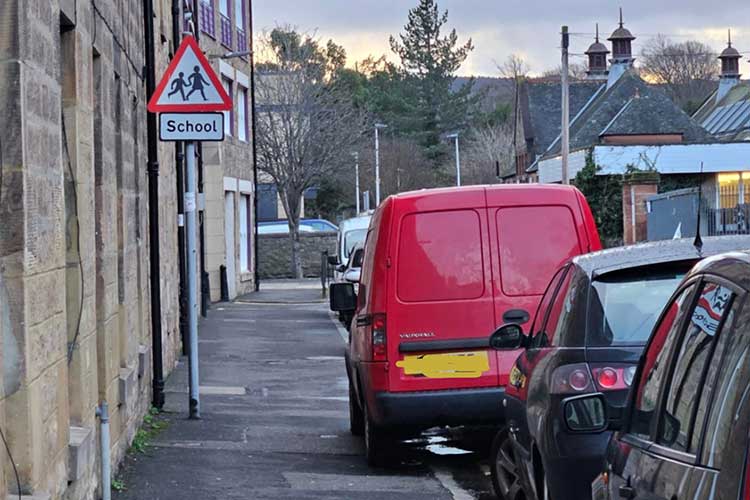
Pavement parking on Croft Street, Dalkeith
This View is written by Philip Reilly
Croft Street’s safety problems were already known. The schools were closed, the traffic was quieter and there was time to act. So what has changed?
For seven weeks, Croft Street in Dalkeith has been quieter than usual.
No school bells. No daily rush of parents dropping off or collecting children. No normal school-time pressure on a street which residents have repeatedly highlighted as suffering from illegal and inconsiderate parking, poor visibility and inadequate enforcement.
Those seven weeks presented Midlothian Council with something valuable: time.
Time to investigate properly. Time to speak to residents. Time to review the existing restrictions. Time to consider whether the current School Street arrangements are actually enforceable in practice. And, above all, time to put measures in place before children return.
Yet as the new school term approaches, residents looking along Croft Street could reasonably ask one very simple question:
What has actually changed?
A problem hiding in plain sight
The problems on Croft Street are hardly invisible.
Vehicles can regularly be seen parked on double yellow lines, partly on pavements and close to junctions. At times, vehicles are positioned in ways which restrict sight lines for motorists and make it more difficult for pedestrians and other road users to see — and be seen.
This is particularly concerning on a street associated with school access.
The photographs accompanying this article are not intended to suggest that a single image can establish every circumstance of an individual parking contravention.
They demonstrate something more important: a recurring pattern.
Over an extended period, residents have documented the same types of parking behaviour, in the same locations, repeatedly.
That matters because road safety is not simply about issuing parking tickets after something has gone wrong.
It is about preventing dangerous situations developing in the first place.
A child stepping from behind a badly positioned vehicle does not care which authority was technically responsible for enforcement.
Neither does a cyclist approaching an obscured junction, a wheelchair user negotiating a restricted pavement, or a driver attempting to emerge without a clear view of approaching traffic.
A School Street that needs meaningful enforcement
Croft Street is subject to School Street access restrictions at specified times.
But restrictions are only effective if there is a realistic prospect of enforcement.
This exposes what appears to be one of the fundamental weaknesses of the present system.
Where breaches remain matters for Police Scotland rather than routine civil parking enforcement, the Council’s own parking attendants cannot simply enforce them in the same manner as ordinary parking restrictions.
That raises an obvious question.
Is the current enforcement model actually fit for purpose?
If not, Midlothian Council should examine what legislative and regulatory changes are available to allow appropriate civil enforcement of the restriction, rather than continuing with a system which appears to depend heavily upon limited police resources.
That should include properly examining whether enforcement can be transferred or enabled through an appropriate decriminalised or civil enforcement mechanism and, where legally available and proportionate, whether approved camera enforcement could form part of the solution.
The precise legal mechanism is ultimately for the relevant authorities to determine.
What residents should reasonably expect is for somebody to determine it.
Simply having a restriction printed on a sign is not enough.
Seven weeks in which something could have been done
This is what makes the school summer holiday particularly significant.
Nobody expected Croft Street to be completely redesigned in seven weeks.
But seven weeks was ample time to demonstrate progress.
The Council could have undertaken site observations, reviewed road markings and signage, examined the operation of the School Street, spoken directly with affected residents and businesses, reviewed enforcement options and published an explanation of what it intended to do before pupils returned.
Residents could have been invited to a meeting.
A consultation could have been publicised.
Letters could have been delivered.
A questionnaire could have been issued.
Even an update explaining what was being considered would have demonstrated that the concerns were being actively addressed.
Instead, residents remain unclear about what, if anything, has been achieved.
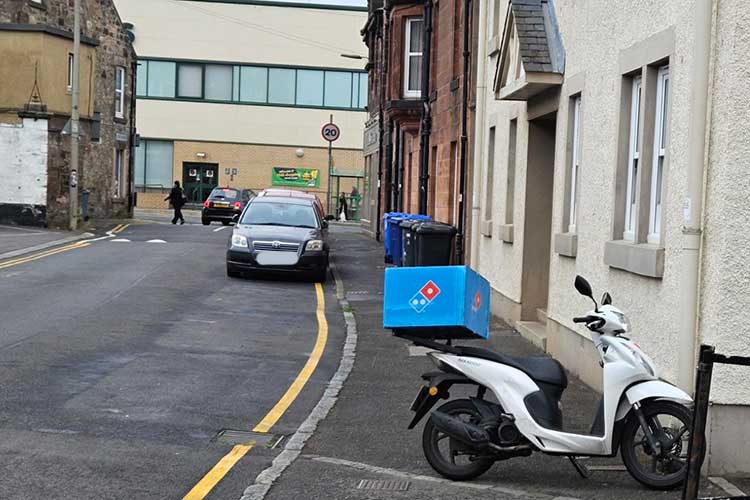
Parking on Croft Street, Dalkeith
“Consulting with residents” — which residents?
This becomes particularly important because Midlothian Council has indicated that engagement or consultation with residents forms part of its approach to the issues surrounding Croft Street.
Yet residents directly affected by the problems appear to have remarkably little knowledge of such a process.
Where are the meetings?
Where are the letters?
Where is the consultation?
What proposals have residents been asked to consider?
And what conclusions have been reached?
These questions have now taken on greater significance because the situation on Croft Street has been brought to the attention of the local Member of Parliament for Midlothian.
Concerns have been raised with the MP not only about parking and road safety themselves, but also about the apparent difference between assurances that residents are being engaged and the experience of residents who remain unaware of any meaningful consultation taking place.
That does not require anyone to accuse the Council of dishonesty.
It requires something much simpler:
transparency.
If consultation has taken place, the Council should explain when it happened, how residents were contacted, what they were asked and what was learned from it.
If meaningful consultation has not yet taken place, then residents should be invited to participate now.
This is bigger than parking tickets
There is a danger that this entire debate becomes reduced to the number of Penalty Charge Notices issued.
That misses the point.
Parking enforcement is not supposed to be a competition to issue the greatest number of tickets. The purpose of enforcement is deterrence. Successful enforcement changes behaviour.
Drivers who know there is a genuine likelihood of receiving a penalty think twice before parking on restrictions. Regular patrols establish expectations. Consistent enforcement prevents individual breaches gradually becoming accepted behaviour.
The opposite is also true.
When drivers repeatedly see vehicles parked on restrictions without apparent consequence, the restriction loses credibility.
One vehicle becomes two.
Two become five.
And eventually illegal or inconsiderate parking begins to look normal.
That appears to be precisely the culture residents fear is developing.
Photographs cannot simply be dismissed
There is another important point regarding photographic evidence submitted by residents.
Of course, an individual photograph will not necessarily establish every fact required to prove that a parking contravention occurred. The circumstances of each case have to be considered.
But exactly the same principle applies to the Council’s own enforcement activity.
Parking attendants do not issue Penalty Charge Notices merely because they have taken a photograph of a vehicle.
They first assess the applicable restriction and surrounding circumstances before deciding whether a contravention has occurred. Photographs then become part of the evidential record supporting that assessment.
Residents’ evidence deserves to be viewed sensibly in the same way.
Nobody is suggesting that every photograph automatically proves an individual offence.
The significance lies in the collective evidence.
A substantial contemporaneous photographic record showing repeated parking behaviour, recurring locations and apparent breaches over an extended period cannot reasonably be dismissed on the basis that one photograph, considered in isolation, might not tell the entire story.
It is the pattern that requires investigation.
What happens when the schools return?
That is now the immediate question.
The quiet summer window is almost over.
Children will return. Parents will return. Traffic will increase and Croft Street will once again experience the pressures that prompted these concerns in the first place.
Residents should not have to wait for an accident or serious near miss before action becomes urgent.
Nor should Police Scotland be expected to provide the everyday enforcement presence necessary to make a local traffic-management scheme function effectively if there is a better mechanism available.
This is an opportunity for Midlothian Council to show leadership.
Explain what has been done during the summer.
Publish the outcome of any consultation already undertaken.
Engage directly with the residents and businesses of Croft Street.
Review whether the existing School Street enforcement arrangements are effective.
Examine the legal options for civil or camera-based enforcement.
And establish a visible, consistent enforcement presence against parking which compromises safety and access.
None of those requests is unreasonable.
Residents are not asking for every driver to receive a parking ticket.
They are asking for restrictions which already exist to mean something.
They are asking for pedestrians to be able to use pavements safely.
They are asking for junctions to provide adequate visibility.
They are asking for children travelling to and from school to be protected by more than a sign.
And they are asking to be included in decisions being made about their own street.
Croft Street has already waited through another seven-week summer.
The opportunity to prepare has passed.
The opportunity to act has not.
Tweet Share on Facebook