Monday November 23rd 2026

Director or Edinburgh Woerld Heritage Terry Levinthal
Written by Midlothian View Reporter, Liam Eunson
Head of Edinburgh World Heritage Terry Levinthal has argued that the council’s engineering consultants have not established whether South Bridge can accommodate the proposed tram infrastructure, raising questions over structural capacity, strengthening works and the potential impact on the historic streetscape.
Speaking to the Midlothian View, Levinthal highlighted that the engineering report identifies missing information about the bridge’s foundations, condition, materials and the depth of the historic arches above the Cowgate. He argued that installing concrete track-supporting slabs could impose additional loads on the bridge, adding that further investigation is required.
“There is no evidence that exists that would support the ability of the bridge being able to take a tram load,” he explained.
The council approved the strategic business case for the proposed north-south tram extension in September, agreeing to prioritise the southern section linking the city centre with the Edinburgh BioQuarter and Royal Infirmary.
The wider plans would connect the route with Granton in the north, but councillors agreed that further work was needed on the northern section. The next stage will involve aligning the proposals with a regional transport study, SEStransit, expected to report in autumn 2027.
The Director of Edinburgh World Heritage said the lack of evidence should not be taken as confirmation that the structure is suitable for the proposed extension.
“No evidence of an impact simply means you haven’t gone looking for it,” he said.
Levinthal warned that further investigations could identify a need for structural strengthening or other interventions to accommodate the tram tracks, potentially creating additional challenges for the historic bridge.
He also questioned whether the infrastructure could be installed without changing the existing road level, pointing to uncertainties over the depth of the material above the bridge’s arches.
He said: “All of these things might have a technical solution, but the technical solution could be so damaging that the benefits you’re seeking may not be beneficial.”
One option outlined in a report commissioned by Edinburgh Council and prepared by engineering consultancy Jacobs is to raise the road surface to accommodate the tram tracks if there is insufficient space to install them at the existing level. The report proposes embedding the rails in reinforced concrete track slabs, which would need a combined depth of at least 406mm. However, the depth of the material between the road surface and the tops of the historic arches remains unknown. Jacobs said further investigations, including excavating trial pits, would be needed to establish whether the tracks could be fitted without raising the road level.
South Bridge spans the Cowgate, with the historic arches forming part of the structure supporting the road above. Any tram extension would need to accommodate the additional infrastructure required for the tracks, including the supporting track bed.
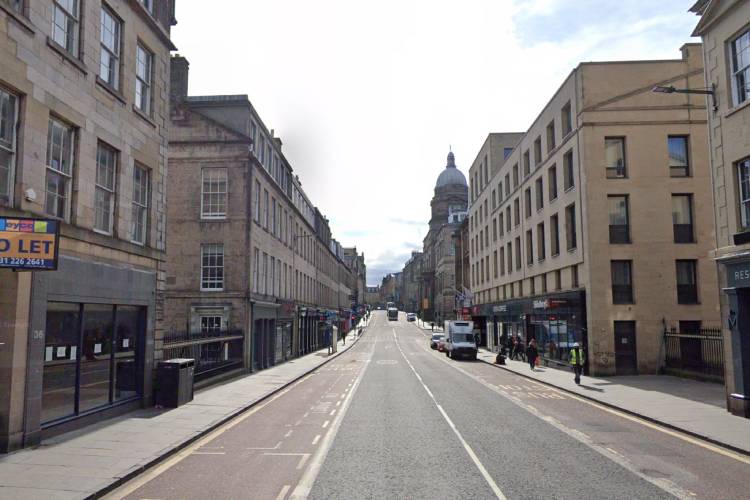
Edinburgh's South Bridge is a 19-arch stone road bridge completed in 1788 that spans the Cowgate valley, linking the High Street to Nicolson Street
Levinthal’s concern is that key details about the bridge’s foundations, condition and construction remain unknown. Without that information, he argues, it is difficult to establish whether the existing structure could safely accommodate the additional loads or whether strengthening work would be required.
The potential complications extend below street level, where South Bridge’s historic arches are concealed behind buildings and divided into vaulted spaces used for a range of purposes. The Jacobs report, published in August 2025, states that some vaults are used commercially, while others may be inaccessible or have private entrances through neighbouring properties. It found no comprehensive survey establishing the full layout or access arrangements.
Levinthal warned that the spaces’ mixed ownership could create further difficulties if structural work were required. He suggested that compulsory purchase of some of the vaults could ultimately be necessary, potentially adding cost and delays to the project.
“You will need them [Edinburgh Council] to ultimately compulsorily purchase most of the vaults”, he explained.
Jacobs has said it is unknown how many of these vaults are currently used or accessible but they have historically been used for storage and commercial purposes, with some now serving business premises and visitor attractions.
In its South Bridge Structures Report, engineering consultancy Jacobs said it had found no comprehensive survey detailing the vaults’ dimensions or access arrangements. The spaces can generally only be reached through the basements of adjoining buildings, and it remains unknown how many are currently in use or accessible.
The report also notes that some vaults have been divided into additional levels since the original arches were built, adding to the complexity of understanding the structure beneath the road.
Levinthal questioned whether alternative routes should be explored, pointing to other streets that could potentially accommodate the extension.
“You could take it along Nicholson Street or you could take them along Lothian Road,” he said.
The head of Edinburgh World Heritage stressed that his concerns about South Bridge did not mean he opposed innovation or expanding Edinburgh’s public transport network.
He said the city’s World Heritage Site should be considered as part of a wider regional transport network, with improved connections potentially benefiting communities beyond the capital.
“The World Heritage Site doesn’t sit in isolation. It’s connected in this regional network that goes forward,” he said.
He acknowledged that light rail could play a positive role in improving connectivity, but warned that individual schemes could also have negative consequences for the historic environment.
“Light rail systems like trams can actually be really positive contributors to that, but they can have really specific negative consequences,” he said.
Levinthal called for a fresh assessment of the project, arguing that decisions already made should not determine how unresolved engineering and heritage issues are addressed.
“We need a first principles review,” he said.