Friday October 2nd 2026
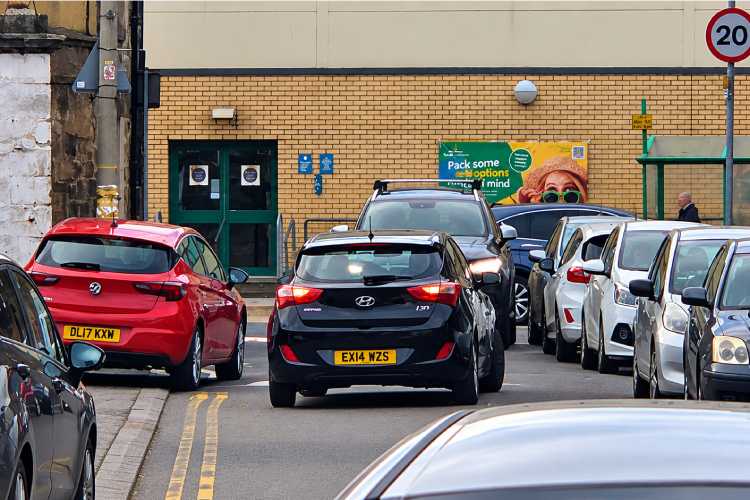
Pavement parking in Dalkeith
This article has been written by Midlothian View reader, Philip Reilly
Cars on pavements. Vehicles on yellow lines. Junctions obscured. School restrictions ignored. Perhaps Midlothian’s biggest parking problem is that we have simply become used to it.
Take a walk through almost any busy town in Midlothian and look at how we use our streets.
– A car partly across a pavement.
– Another sitting on double yellow lines.
– A vehicle parked so close to a junction that drivers have to edge forward to see past it.
– A delivery vehicle stopped wherever space can be found.
– Cars entering a School Street during the restricted period.
Most of us barely look twice anymore.
And perhaps that is the most worrying part.
When did we decide this was normal?
Imagine the street without the cars
This isn’t really an article about parking tickets.
It is about what happens when repeated behaviour gradually changes what we are willing to accept.
A badly positioned vehicle can obscure a child from a driver’s view.
Parking across a pavement can leave someone with a wheelchair, mobility aid or pushchair with less space to pass.
Parking around junctions can reduce the ability of drivers, cyclists and pedestrians to see one another.
Too many vehicles around a school can turn what should be an ordinary walk to class into a complicated interaction between children, pedestrians and moving traffic.
Yet because we see these things every day, they can begin to feel ordinary.
They shouldn’t.
The rules exist for a reason.
– Double yellow lines aren’t decoration.
– Junction restrictions aren’t there to make parking inconvenient.
– Pavements aren’t spare parking spaces.
– And a School Street isn’t simply a sign at the entrance to a road.
Behind each restriction is a basic principle: Think About the Other Person
That includes motorists.
But it also includes the child walking to school, the cyclist approaching a junction, the older person crossing the road, the wheelchair user trying to use a pavement and the resident attempting to leave their own street.
This is where the conversation about parking needs to change.
It isn’t drivers versus pedestrians.
Most pedestrians are drivers at some point. Most drivers are pedestrians after they park.
We all use the same streets.
What happens when enforcement becomes unlikely?
There is another human behaviour at work.
If people repeatedly see a restriction ignored without consequence, eventually some will conclude that the restriction doesn’t really matter.
One car parks there – Nothing happens.
Another does the same – Then another.
Eventually the unusual becomes routine.
And once that culture becomes established, putting up another sign is unlikely to solve it.
Enforcement isn’t valuable because councils should be trying to issue as many tickets as possible.
Good enforcement should achieve precisely the opposite – It should make people less likely to break the restriction in the first place.
The real measure of success isn’t how many tickets have been issued.
It is whether behaviour has changed.
Croft Street is one example, but this is bigger than Croft Street
I have spent years documenting these problems around Croft Street in Dalkeith.
The evidence now runs into hundreds.
During one recent day I observed 21 vehicle entries during the two School Streets restriction periods which appeared not to fall within the permitted categories.
Because Croft Street is a dead end, those entries potentially meant 42 vehicle movements through an area being heavily used by pedestrians.
But I don’t believe Croft Street is unique.
That is precisely the point.
What happens outside your school?
What happens on the residential street beside your town centre?
Can you see clearly when you pull out of your junction?
Can someone using a wheelchair get along your pavement?
Do restrictions where you live actually change behaviour?
Or have you simply become accustomed to seeing them ignored?
Midlothian now has an opportunity
Midlothian Council has confirmed that it is developing a new Midlothian-wide parking strategy, with a report currently intended to go before Council in November.
That could be an important opportunity.
But this conversation should not belong only to council officers, parking attendants, police officers or people like me who have spent years corresponding about it.
It belongs to everyone who uses our streets.
Residents.
Parents.
Businesses.
Disabled road users.
Cyclists.
Pedestrians.
And motorists.
Before deciding what Midlothian’s future parking strategy should look like, perhaps we should first look honestly at what our streets have become.
Not everything can be fixed with another yellow line.
Not every badly parked vehicle requires a penalty.
And no road system will ever eliminate inconsiderate behaviour completely.
But we should at least be able to agree on what success looks like.
– Safe pavements.
– Visible junctions.
– School restrictions that actually reduce unnecessary traffic.
– Parking restrictions which command enough respect to change behaviour.
– And residents who can see measurable improvement in their communities.
So next time you walk through your own neighbourhood, don’t just look at whether there is somewhere to park.
Look at the street through somebody else’s eyes.
– Imagine you’re eight years old and crossing between those cars.
– Imagine you’re using a wheelchair and approaching that pavement.
– Imagine you’re cycling towards that obscured junction.
– Imagine that’s your child walking to school.
Then ask yourself:
Have we really decided this is normal?
Because if the answer is no, Midlothian’s forthcoming parking strategy is an opportunity to decide what normal should look like instead.
Tweet Share on Facebook