Monday November 23rd 2026
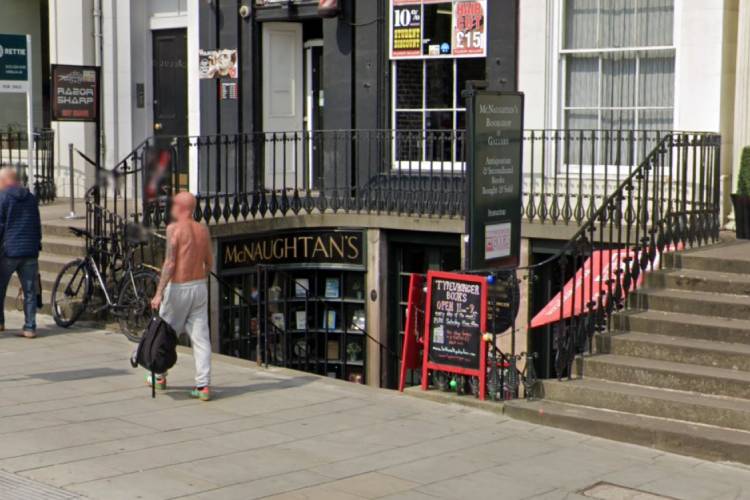
McNaughtan’s Bookshop on Leith Walk
Written by Local Democracy Reporter, Nicholas Malizia
Edinburgh business owners are seeking licensing exemption as council officials are poised to revise a decades-old policy.
Some traders say the current rules are “excessively onerous” on local businesses, calling on lawmakers to loosen them.
The debate concerns the sale of second-hand goods. A 1983 Edinburgh Council regulation requires second-hand dealers to be licensed when selling stamps, books, antiques, jewellery, cars, clothes, furniture, electrical and gas goods, and “general goods”.
Critics said licensing is meant to prevent crime and uphold public safety – but claimed many second-hand goods carry no such risks and the current rules are “burdensome”.
They cited licence fees, long processing times up to six months and excessive “red tape” – with goods valued above £50 requiring sellers to provide a photo ID.
A consultation on the matter received 28 responses, almost entirely from second-hand clothing and bookshop owners across Scotland. Edinburgh objectors included established, much-loved businesses like Armchair Books, Tills Bookshop, Torn Vintage, and Carnivàle Vintage.
Antiquates Ltd called the Edinburgh policy an “anomaly” with most second-hand book shops not requiring a licence elsewhere in the UK, according to a report.
A representative from Armchair Books said the rule made “absolutely no sense”, pointing out that books are very rarely stolen and are “almost never individually identifiable”.
They stated: “Selling new books doesn’t require licensing, presumably because it can be agreed that the items themselves are not a threat requiring supervision. We sell the same items.”
The representative asserted antique bookshops uphold Edinburgh’s heritage as a UNESCO City of Literature, adding: “The council should be supporting us to survive, not making it increasingly difficult.”
Derek Walker, co-owner of McNaughtan’s Bookshop on Leith Walk, addressed councillors on Monday. He said books are “not dangerous, not common targets of theft, not easily fenced, and not able to be melted down for inherent material value.”
The rules make it extremely difficult to hold book fairs in Edinburgh, he claimed, since vendors need a licence “far in advance of knowing when they might want to do a book fair”.
Mr Walker shared: “This chokes off considerable potential for economic activity. The largest book fair in Edinburgh has fewer than 50 exhibitors, and the median has only seven – while York, less than half Edinburgh’s size, has a book fair with over 180 exhibitors and its smallest event has at least 75.”
Officers at the Regulatory Committee meeting on Monday, November 23 acknowledged the policy was “out of date” and carried logistical concerns.
Cllr Jo Mowat (Con) observed it would be challenging to regulate Edinburgh-based sellers of used clothing on popular sites like Vinted or eBay. She said: “I’m wary of expanding something with onerous conditions for sellers if it’s almost impossible to enforce.”
Convener Neil Ross (Lib Dem) said there was “clearly” a need for a licence where theft or public safety was a particular concern – such as with cars, jewellery, and electrical and gas goods.
But he added: “I’m less convinced to include other second hand businesses. A lot has changed in the last 40 years. We want to make sure to include the most appropriate classes of second hand business.”
Councillors agreed to seek evidence from Police Scotland about whether exempt booksellers and other second-hand businesses from licensing would carry risks to crime prevention.
Cllr Chas Booth said: “I hope this will lead to [the] outcome that booksellers are withdrawn from the list but also that there’s evidence base for it.”
Tweet Share on FacebookNews