Monday October 5th 2026

House extension (photo by Brett Jordan)
Written by Midlothian View Reporter, Liam Eunson
Half of Scottish building firms with overdue accounts were insolvent, had been struck off or were facing strike-off within a year, according to new analysis by insolvency firm Clarke Bell.
The research suggests homeowners in Scotland can spot a higher-risk builder before handing over a large deposit simply by checking one date on the free Companies House register.
Clarke Bell tracked 19,877 trading building and trades companies registered in Scotland that were active and at least a year old on 1 September 2025, and followed what happened to them over the next 12 months.
Of the 401 Scottish firms whose accounts were overdue at the start of the study, 49.6% had entered insolvency, been removed from the register or were facing strike-off a year later.
That compares with 10.6% of Scottish firms whose accounts were up to date, making those with overdue accounts 4.7 times more likely to go bust or face being struck off.
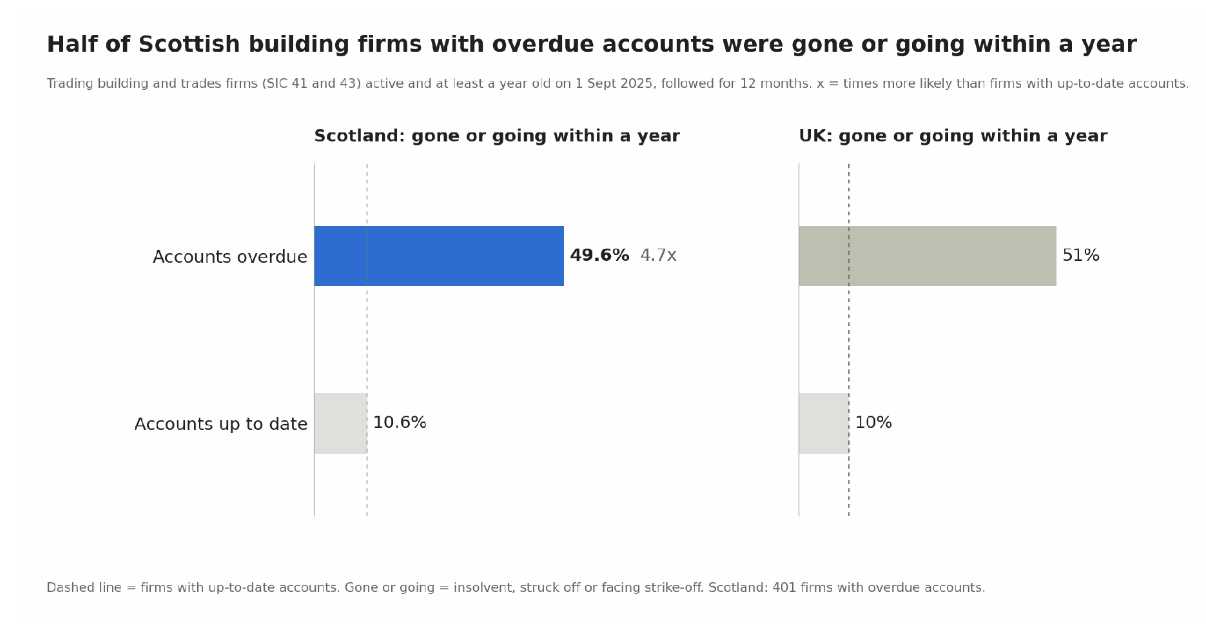
The pattern was the same a year earlier. In the 2024/25 figures, Scottish builders with overdue accounts were 4.9 times more likely to be gone or going within 12 months.
The Scottish results closely mirror the UK-wide picture, where half (51%) of building firms with overdue accounts were gone or going within a year, against one in ten (10%) of those that were up to date.
The Two-Minute Check Homeowners Can Make
Before paying a significant deposit to a builder trading as a limited company, Clarke Bell recommends five simple checks:
1. Look the company up on the free Companies House register. If the trading name is different, ask for the registered company name or company number.
2. Check whether its accounts are overdue. If the due date has passed, ask why before paying anything.
3. Check whether its confirmation statement is overdue. This is a strong sign that a company may be struck off.
4. Search The Gazette for a winding-up petition.
5. Keep deposits small and pay by credit card where you can. Section 75 of the Consumer Credit Act can make the card provider jointly liable for items costing more than £100 and no more than £30,000.
John Bell, Senior Partner and Licensed Insolvency Practitioner at Clarke Bell, said:
“When a building company goes into liquidation, customers who have paid a deposit usually join the queue of unsecured creditors, and they rarely get much back. Overdue accounts are often one of the first public signs that a company is struggling. It takes two minutes to check, and it could save you thousands.”
The research comes as the government backs new measures aimed at improving consumer protection in the home-improvement market, including an Approved Code for participating businesses and a Trusted Payments service designed to protect customers’ money while work is completed.
What the Checks Can and Can’t Tell You
Clarke Bell stresses that a warning sign raises the odds rather than predicting what will happen to any individual company. Companies can also be struck off for reasons other than business failure.
The checks apply only to limited companies. Sole traders and partnerships are not on the Companies House register.
Tweet Share on Facebook